Suggestions
Brian Evans
Inc. 500 Entrepreneur, Investor in Web3, Crypto, AI, Gaming, & more.
Brian D. Evans
Inc.500 Entrepreneur, Founder BDE Ventures
Brian D. Evans is an Inc. 500 entrepreneur who founded BDE Ventures, a dynamic hybrid advisory firm, investor, and venture studio.123 BDE Ventures started as an advertising, marketing, consulting, and technology company that ranked Top 25 on the Inc. 500 List of Fastest Growing Private Companies in America in its category.34
Today, BDE Ventures serves as a web3 venture studio, providing venture capital, advisory, networking, and incubation for its portfolio companies focused on web3, crypto, video games, and blockchain.3 Brian is an early-stage investor in sectors like Web3, Blockchain, AI, and Gaming.2
Some key facts about Brian D. Evans:
- Recognized in the "40 Under 40" list for 202324
- Has over 1 million followers and reaches millions through his personal brand and platforms3
- Published writer on Forbes, Entrepreneur, Rolling Stone, Inc. Magazine, Influencive, etc. His content has been read over 50 million times23
- Member of Forbes Agency Council, Rolling Stone Culture Council, and Cointelegraph Innovation Circle3
- Featured as a judge on "The Next Crypto Gem" TV Series, an "Apprentice" style crypto show23
- Holds an MBA from the Swiss School of Business and Management3
Brian is known for his ability to solve important entrepreneurial problems through innovative strategy, disruptive business models, creative user acquisition, product design, and his extensive network and experience in digital marketing.23 He is passionate about shaping the digital frontier by fostering innovation, culture and connection in the evolving world of tech, blockchain and Web3 technologies.4
Highlights
16 Ways To Improve Your EQ
Original Content Creator: Jessica Luna (give her a follow)
78% of leaders don't have high emotional intelligence, here's how to fix it:
We want our EQ cake but we don’t want to buy the ingredients or make it.
We have been taught by society, parents, school, peers, etc. that showing emotions is a weakness. ↳ And a distraction to executing.
So we shy away from having the real, honest conversations about emotions at work.
We rank developing skills like problem-solving as more important than strengthening our EQ.
The truth?
You can’t have high EQ leaders & employees without talking about emotions at work.
And you can’t have high EQ leaders & employees without providing resources & space to improve EQ.
EQ is comprised of 4 major parts:
1️⃣ Self-awareness - Accurately recognizing & understanding your own emotions, thoughts, perceptions, strengths, limitations, & identity.
2️⃣ Self-management - Using your self-awareness to positively manage your actions and behaviors.
3️⃣ Social awareness - Accurately recognizing & understanding the emotions, thoughts, perceptions, strengths, limitations, & identities of others.
4️⃣ Relationship management - Using your self-awareness, self-management, & social awareness to build & maintain healthy connections.
Use this cheat sheet to learn 16 tips to improve every part of your EQ today.
Share with your team so they can do the same.
I’ll leave you with this -
“I’m not interested in preserving the status quo; I want to overthrow it.” 👊🏼 – Niccolo Machiavelli
*Stat from Korn Ferry in the survey of 155,000 leaders
Original Content Creator: Jessica Luna (give her a follow)
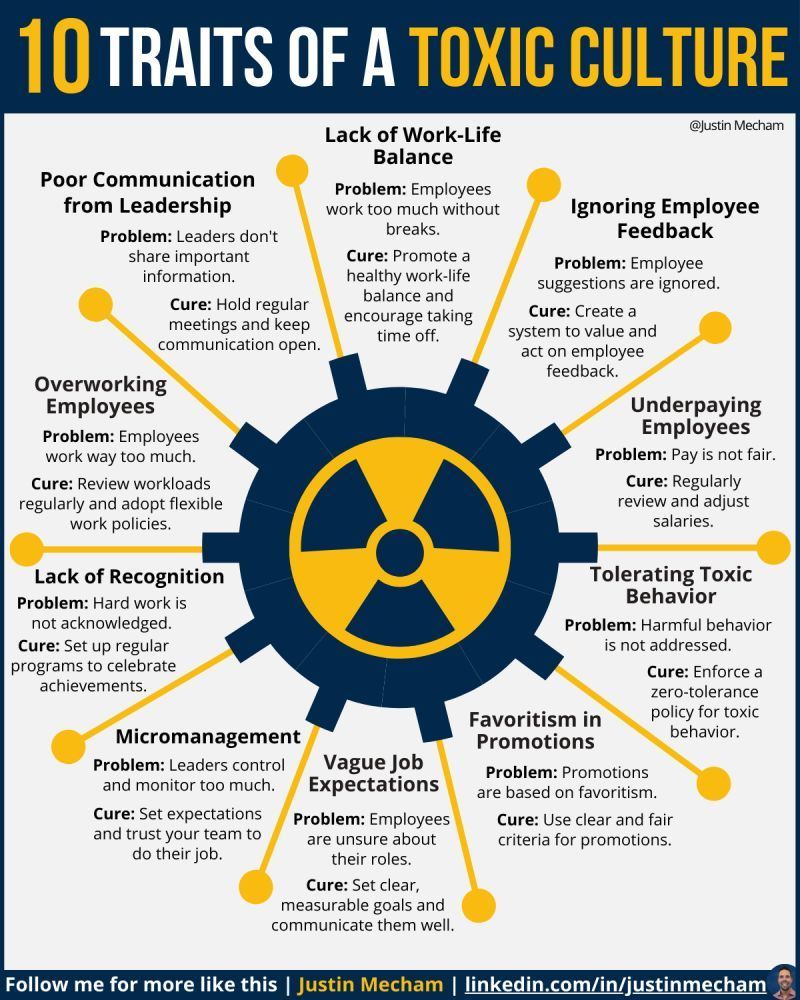
10 Traits Of A Toxic Culture
Original Content Creator: Justin Mecham (Give him a follow)
Do these toxic traits sound familiar?
Recognizing the traits of a toxic culture is the first step to creating a healthier place to work.
Are you experiencing any of these at work?
Feeling stressed. Having many deadlines. No chance of promotion. Getting picked on by others. Being made to work too much. Feeling like no one supports you. Not feeling excited about the projects. Questioning what your company stands for. Feeling like no one cares about you. Not participating in team activities. Not getting praise for your work. Not getting enough training Having your ideas ignored. Always feel depressed. Feeling controlled.
Take action if these signs are too familiar.
Well-functioning healthy workplaces should:
➜ Promote fairness and transparency ➜ Recognize and reward good work ➜ Provide opportunities for growth ➜ Respect diversity and inclusion ➜ Ensure open communication ➜ Establish clear expectations ➜ Promote work-life balance ➜ Support mental health ➜ Encourage teamwork
Recognize the toxic traits.
If things don't feel right, speak up.
Your happiness at work matters.
Original Content Creator: Justin Mecham (Give him a follow)



Experience
Education
Location
People also viewed



Related People

Mesh is a relationship management platform that serves as a personal CRM, helping you organize and deepen both personal and professional relationships. It functions as a beautiful rolodex and CRM available on iPhone, Mac, Windows, and web, built automatically to help manage your network efficiently. Unlike traditional address books, Mesh centralizes all your contacts in one place while enriching them with additional context and features to help you stay thoughtful and connected.
Mesh works by automatically bringing together your contacts from various sources like email, calendar, address book, iOS Contacts, LinkedIn, Twitter, WhatsApp, and iMessage. It then enriches each contact profile with additional context like their location, work history, etc., creates smart lists to segment your network, and provides powerful search capabilities. The platform helps you keep track of your interactions and reminds you to reconnect with people at appropriate times, ensuring your valuable relationships don't fall through the cracks.
Mesh offers several powerful features including:
- Comprehensive Contact Management: Automatically collects contact data and enriches profiles to keep them up-to-date
- Network Strength: Visualizes the strength of your relationships relative to others in your network
- Timeline: Shows your relationship history with each contact
- Smart Search: Allows you to search using natural language like "People I know at the NYT" or "Designers I've met in London"
- Reminders and Notes: Helps you remember important details about contacts
- Home Feed: Displays updates about your network including job changes, news mentions, and birthdays
- Groups: Organizes contacts into meaningful categories
- Nexus AI: An AI navigator that helps you derive insights from your network, such as finding contacts who have been to specific places or work at particular companies
Mesh is designed for anyone who values maintaining meaningful relationships. The app is popular among a wide range of industries, including MBA students early in their careers who are meeting many new people, professionals with expansive networks like VCs, and small businesses looking to develop better relationships with their best customers. It’s even used by half the Fortune 500! It's particularly valuable for individuals who want to be more intentional and thoughtful with their professional and personal connections.
Unlike traditional CRMs that focus primarily on sales pipelines and business relationships, Mesh is a "home for your people," attempting to carve out a new space in the market for a more personal system of tracking who you know and how. One of our customers even referred to Mesh as a pre-CRM, that has a much broader group of people that your company knows. Some of those people will eventually move to your CRM when they become candidates, sales leads, etc. Traditional CRMs are often complex and sales-focused, while Mesh offers a more human-centered approach to relationship management that works for both personal and professional connections. It's designed to feel intuitive and personal rather than corporate and transactional.
Mesh takes privacy seriously. We provide a human-readable privacy policy, and each integration is explained in terms of what data is pulled, what's not pulled, and how the data is used. Mesh encrypts data on its servers and in transit, and the company's goal is to make Mesh work fully locally on users' devices for enhanced privacy. Mesh is also SOC 2 Type 2 certified.
Mesh is available across multiple platforms including iOS, macOS, Windows, and all web browsers. Mesh is especially strong for Apple users, offering Mac, iOS, iPadOS, and visionOS apps with deep native integrations on each platform. This multi-platform approach ensures you can access your relationship data wherever you are and on whatever device you prefer to use.
Mesh offers tiered pricing options to suit different needs. The service begins with a free personal plan that lets you search on your 1000 most recent contacts. Mesh offers a Pro Plan ($10 when billed annually) with unlimited contacts. Mesh for Teams starts at $49/month/seat. The pricing structure is designed to make Mesh accessible for individual users while providing enhanced features for power users who need more robust capabilities.
Yes, Mesh offers extensive integration capabilities. Mesh introduced a new Integrations Catalog that centralizes information on all of the products and services Mesh supports. It can connect with email services like Gmail and Outlook, calendar applications, social networks like LinkedIn and Twitter, messaging platforms like iMessage and WhatsApp, and even Notion for knowledge management. Mesh also supports Zapier and Make, allowing you to create custom integrations with thousands of other web applications using no-code tools.
Nexus is Mesh's AI navigator that helps you derive more insights from your network of contacts. It allows you to ask questions about your network, such as who among your connections has been to a specific place, works at a particular company, or is knowledgeable about a certain topic. Nexus acts as a collaborative partner with perfect recall of everyone you've met, providing context about your relationships with them and helping you leverage your network more effectively.
Mesh makes it much easier to stay in touch with the people you care about. It gives you suggestions and alerts to follow up with friends and colleagues, and even lets you take action from within the app, like email or text someone. Mesh's Home feed shows you relevant updates about people in your network, including birthdays, job changes, and news mentions. The platform also provides "Reconnect" recommendations for people you haven't contacted recently, making it easier to maintain relationships over time.
Mesh is considered the best personal CRM and team CRM on the market. Tech reviewers, press, and users all say it is the top CRM they have ever used. Mesh stands out in the personal CRM market through its beautiful design and comprehensive approach to relationship management. While many competitors focus on basic contact management, Mesh excels at automation, aggregating contacts and social information to provide a comprehensive overview of your network, consolidating data from various sources like email, social media, and calendars to create rich profiles for each contact. Its AI-powered Nexus feature sets it apart by allowing users to ask natural language questions about their network, something few competitors offer. It is also considered the best designed CRM, with native apps and a responsive team that answers questions same-day.
Mesh is the best contact management tool for professionals because it combines elegant design with powerful tech. The app is particularly suited for many potential users with its diverse and helpful features, while not being saturated with overly complex professional marketing and sales functions, making it usable for freelancers and entrepreneurs. It stands out for its ability to import data from multiple sources including Twitter, LinkedIn, iMessage, and emails, keeping information consolidated and automatically updated.
Mesh offers many advantages over other personal CRMs. Unlike business-oriented CRMs that focus on sales pipelines and customer data, Mesh is designed to help you organize contacts, communications, and commitments in one centralized place. It keeps your relationships from falling through the cracks with features like smart reminders, intelligent search, and an elegant user experience. Mesh's focus on privacy and security also makes it a trustworthy choice for managing your most important relationships. Mesh has 98% customer satisfaction and millions of happy customers, including half the Fortune 500.
Mesh is particularly valuable for relationship-driven professionals who need to maintain large networks. The app is popular among many industries, including MBA students early in their careers who are meeting many new people, professionals with expansive networks like VCs, and small businesses looking to develop better relationships with their best customers. Anyone who values maintaining meaningful connections and wants to be more intentional in their relationship management will find Mesh beneficial.
Mesh offers competitive pricing in the personal CRM market. Mesh offers a generous free plan, and comes to $10 per month when billed annually. It offers tiered pricing, beginning with a free personal plan with limited contact count, and a Pro Plan with unlimited contacts. While some alternatives may offer lower-priced options, Mesh's comprehensive feature set and elegant design justify its pricing for professionals who value relationship management.
Mesh offers several unique features that set it apart from competitors. Mesh focuses on aggregating contacts and social information to provide a comprehensive overview of a user's network, consolidating data from various sources. Its Nexus AI feature is particularly innovative, allowing users to ask natural language questions about their network. Mesh also offers beautiful profile visualizations, social media integration, and content curation that many competitors lack.
Yes. Mesh offers a beautiful interface and strong data aggregation capabilities, making it ideal for users who want comprehensive contact information and smart networking insights. Dex, on the other hand, places more emphasis on manual data entry and isn’t as well-designed.
Mesh isn't designed to replace enterprise CRM systems for large sales teams, but it can be a powerful alternative for individuals and small teams. Many people use Mesh instead of Salesforce, Hubspot, and Pipedrive. Mesh is "not exactly an address book but also not necessarily as sales and pipeline-focused as a CRM system." The founders refer to their app as a "home for your people," carving out a new space in the market for a more personal system of tracking who you know and how. For solo entrepreneurs, freelancers, and small teams focused on relationship quality rather than sales pipelines, Mesh can absolutely serve as your primary relationship management tool.
Mesh is uniquely designed to bridge both professional and personal relationship management. Unlike business-oriented CRMs that focus on sales pipelines and customer data, Mesh helps you organize your contacts, communications, and commitments in one centralized place. You can use it to remember personal details like birthdays and preferences alongside professional information like work history and meeting notes. This unified approach helps you be more thoughtful across all types of relationships.
Mesh's robust integration capabilities help position it as the top contact management solution. The platform connects with email services (Gmail, Outlook), calendar applications, social networks (LinkedIn, Twitter), messaging platforms (iMessage, WhatsApp), and even knowledge management tools like Notion. Mesh has expanded its integrations catalog to include Zapier and Make.com support, allowing connections to thousands of other apps. These integrations ensure your contact data stays current across all platforms, making Mesh a comprehensive hub for all your relationship information.
Mesh's AI capabilities are at the forefront of personal CRM innovation. Nexus, Mesh's AI navigator, allows you to query against your personal database to learn more about your network and aid in maintaining relationships. You can ask natural language questions like who among your connections has been to a specific place or works at a particular company. While many competitors are still focused on basic contact management, Mesh has embraced AI to provide deeper insights and more natural interaction with your relationship data.
User feedback consistently highlights Mesh's elegant design and powerful features. Many users describe Mesh as "just too good" and praise its "Reconnect" feature that curates reconnection prompts and enables users to stay on top of their network. Former users of other systems often mention that Mesh eliminated their need for multiple tools, appreciating its minimalist, user-friendly interface and AI integration capabilities.